Lisbon‘s food markets fall into two categories. Traditional municipal markets sell fish, meat, produce, bread, and pantry goods, mainly in the morning. Modern food halls serve prepared meals and drinks later. For a first visit, choose Time Out for central variety, Campo de Ourique for a shopping-and-eating hybrid, or Alvalade, 31 de Janeiro, or Arroios for a working neighborhood market.
The distinction matters. A traditional market at 4 p.m. may be an interesting building with very little market left; a food hall is no place for quiet grocery shopping.
Lisbon Food Markets at a Glance
| Market | Type | Best for | When to go | Main tradeoff |
|---|---|---|---|---|
| Mercado da Ribeira, traditional section | Municipal fresh-food market | Central produce, fish, cheese, and everyday shopping | Weekday or Saturday morning | Traditional stalls finish early |
| Time Out Market, inside Ribeira | Modern food hall | Mixed-taste groups and an easy central meal | Off-peak lunch or early evening | Busy, shared seating, premium positioning |
| Mercado de Campo de Ourique | Traditional market plus food hall | One-stop shopping and casual eating | Morning for traders; meal hours for restaurants | Requires a deliberate neighborhood trip |
| Mercado de Alvalade Norte | Traditional neighborhood market | A full working-market atmosphere | Tuesday–Saturday morning is the safest plan | Limited reason to go without a shopping interest |
| Mercado 31 de Janeiro | Traditional market with simple food counters | Fish, produce, and a practical Saldanha stop | Tuesday–Saturday morning or early lunch | Closed Sunday and Monday |
| Mercado de Arroios | Traditional market with separate restaurants | Neighborhood shopping and multicultural food | Morning for stalls; check each restaurant separately | Market and tenant hours do not match |
Traditional Market or Food Hall: Choose the Job First
A traditional mercado sells ingredients. Fishmongers, butchers, produce sellers, bakeries, and residents doing ordinary errands set its rhythm. Visit early. Travelers with kitchens can shop seriously; hotel guests should favor fruit, bread, nuts, preserves, or packaged goods that need no cutting board.
A food hall sells meals, trading one restaurant’s focus for choice, speed, and communal tables. It helps when four people want four lunches. It is not automatically authentic because the building is historic, nor bad because visitors know about it. Decide whether you want ingredients, a meal, or both. For dishes and ordering customs, use the separate Lisbon food guide.

Mercado da Ribeira and Time Out: One Building, Two Visits
Mercado da Ribeira in Cais do Sodré causes the most confusion because its traditional market and Time Out Market occupy the same landmark building but follow different rhythms.
Go in the morning for the traditional market
The municipal section operates Monday through Saturday in the morning and early afternoon. Its official listing identifies fresh fish, fruit and vegetables, cheese, groceries, and other traditional counters. This is the side to visit if you want to see a central Lisbon market doing its original job or buy something for a nearby apartment.
It is not a late-lunch attraction. Pair it with a morning around Cais do Sodré or the river, and do not assume that a busy food hall next door means the produce stalls remain open at night.
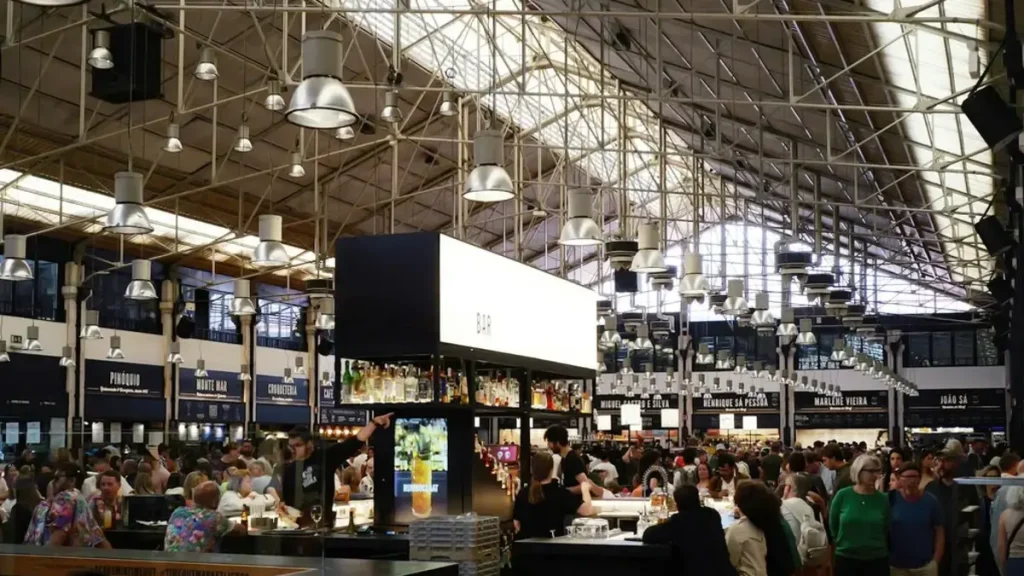
Go later for Time Out Market
Time Out Market’s official site currently lists daily opening from 10 a.m., with restaurants, bars, shops, and communal seating. It is the easiest choice for a group that cannot agree on one menu, for a meal beside a major transport hub, or for weather that has made wandering temporarily less charming.
The tradeoff is predictable. Public discussions repeatedly mention crowds, noise, shared-table competition, and prices that feel higher than at small neighborhood spots. The operator does not take ordinary table reservations. Go outside the main lunch and dinner rush, find a realistic seating plan before everyone orders, and value the range rather than hunting for a secret local canteen. For table-service choices by neighborhood and budget, see the best restaurants in Lisbon.
Mercado de Campo de Ourique: The Best Hybrid
Campo de Ourique keeps traditional fresh-food sellers around a central prepared-food and drink area. The official city directory lists fish, produce, meat, bread, charcuterie, preserves, spices, oils, wine, cafés, restaurants, and bars. It therefore works when one person wants lunch, another wants a bottle or pantry gift, and someone else would simply like to sit down.
Campo is smaller and more neighborhood-oriented than Time Out, but shared seating can still fill. It also takes more effort from the historic center, so pair it with Campo de Ourique or Estrela rather than crossing town solely for lunch. Current city pages publish conflicting hour sets for parts of the complex; treat fresh traders as morning-oriented, restaurants as later-running, and check the listing before leaving. Save it using this Google Maps trip-planning guide is more useful than a three-year-old screenshot.
Traditional Markets Beyond the Tourist Center
Mercado de Alvalade Norte: best for a full working market
Alvalade Norte is the strongest choice when the market itself—not lunch—is the point. The municipal listing describes traditional food retail, services, and restaurants, with fish, produce, meat, bakery, and deli-style counters. Its residential setting and morning schedule make it feel purposeful rather than staged.
Go Tuesday through Saturday morning and verify the parish calendar. At the August 2026 snapshot, Monday operations were temporarily suspended, proof that schedules change. Alvalade suits cooks, market enthusiasts, or longer stays. Without a kitchen, do not cross town merely to prove a preference for local places.
Mercado 31 de Janeiro: best near Saldanha
Near Saldanha, 31 de Janeiro is a practical traditional market with fresh and frozen fish, bacalhau, produce, meat, charcuterie, spices, dried fruit, bakery and café counters, and several restaurant spaces. The Arroios parish currently lists it Tuesday through Saturday from 7 a.m. to 2 p.m., closed Sunday and Monday.
Choose it when staying near Saldanha or Picoas, shopping for fish or pantry foods, or seeking a simple market lunch. Do not cross from Baixa unless working markets genuinely interest you. Its appeal is usefulness, not curation.
Mercado de Arroios: best for traditional stalls plus a separate meal
Mercado de Arroios, near Alameda, combines morning grocery trading with restaurant spaces serving food from different cultures. The parish lists fish, bacalhau, produce, meat, bakery, charcuterie, a grill, cafés, and pantry shops. Municipal market hours are currently Monday through Saturday, 7 a.m. to 2 p.m.
Restaurants are separate businesses with different clocks. Mezze, for example, publishes lunch and evening hours and currently serves Sunday although the municipal market is closed. That makes one restaurant open, not Sunday a market day. Visit in the morning for stalls or confirm a tenant for a meal.

Use Lisbon’s Markets Like a Shopper
- Match the hour to the purpose. Traditional stalls belong in the morning. Food halls and independent restaurant tenants can run later. Check both the market authority and the specific tenant before a special trip, especially on Sundays, Mondays, holidays, and in August.
- Ask before touching or ordering. A simple bom dia, a pointed quantity, and a polite question travel well. Some vendors select and weigh produce for the customer; observation beats assuming the supermarket rules followed you across the Atlantic.
- Carry a payment backup. Time Out officially accepts cash and cards. Small traditional traders set their own policies, so ask before a purchase instead of declaring Lisbon a cashless city after one successful tap.
- Buy for the kitchen you actually have. Raw fish is not a sightseeing companion. U.S. food-safety guidance says seafood should go on ice or into refrigeration within two hours of purchase, or within one hour above 90°F/32°C. Without a refrigerator and cooking setup, choose prepared food or shelf-stable goods.
- Declare food on the way home. U.S. Customs and Border Protection requires travelers to declare meats, fruit, vegetables, and other plant or animal products. Check current rules before buying edible souvenirs; attractive wrapping is not an import permit.
Weather changes how pleasant a market detour feels, and summer can alter operating calendars. Use the best time to visit Lisbon guide for the seasonal decision, then verify the market itself close to the day.
What Not to Count as a Lisbon Food Market
Feira da Ladra is Lisbon’s famous flea market for used objects and crafts, not a food market. Browse it for books, clothes, and vintage clutter with uncertain career prospects, then use the Lisbon shopping districts guide for the fuller context.
Occasional outdoor fairs, craft stalls, holiday programs, and weekend pop-ups near a market building are also not permanent food markets. Check the organizer’s current calendar rather than assuming a scene from last Saturday will reassemble itself for your Tuesday.
Which Lisbon Food Market Should You Choose?
- Choose Time Out for the easiest central meal and the widest group-friendly variety.
- Choose Campo de Ourique for the best balance of traditional stalls, prepared food, and neighborhood context.
- Choose Alvalade Norte to see a substantial working market and shop for ingredients.
- Choose 31 de Janeiro for fish, produce, and a convenient stop when staying near Saldanha.
- Choose Arroios for a morning market with a multicultural restaurant layer, while treating the two schedules separately.
Most first-time visitors need one market, not five. Pick the one that fits where you will already be, arrive at the hour when it performs the job you want, and let Lisbon’s other meals happen somewhere with fewer communal benches.
Frequently Asked Questions
What is the difference between a traditional market and a food hall in Lisbon?
Traditional municipal markets sell fish, meat, produce, bread, and pantry goods mainly in the morning, while modern food halls serve prepared meals and drinks later in the day.
What is the best Lisbon food market for a first visit?
Time Out Market works well for central variety, Campo de Ourique offers a shopping-and-eating hybrid, and Alvalade, 31 de Janeiro, or Arroios suit a working neighborhood market experience.