The Paris foods worth planning around are excellent bread and viennoiserie, a seasonal bistro lunch, cheese bought with advice, one precise pastry rather than a box chosen for photographs, and dishes that reflect the city’s working-class as well as bourgeois history. Croissants and steak-frites belong, but Paris is also North African couscous, Jewish baking, Vietnamese noodles and a constantly changing contemporary restaurant scene.
The best strategy is to assign different food experiences to the places that handle them well. Buy bread from a boulangerie, pastry from a pâtisserie, cheese from a fromagerie and a cooked meal from a restaurant. A café facing a major monument may serve all four. That versatility is usually more convenient than delicious.
The short list: what to eat in Paris
| Food or experience | Where it fits | What to look for |
|---|---|---|
| Baguette tradition | Morning or picnic | Crisp crust, open crumb, sold fresh |
| Croissant or pain au chocolat | Breakfast or late-morning snack | Distinct flaky layers, buttery aroma |
| Seasonal bistro dish | Lunch or dinner | Short menu, changing garnish, confident sauce |
| Croque-monsieur | Quick café or brasserie lunch | Properly browned bread, restrained cheese |
| Cheese | Market or fromagerie | Advice on ripeness and travel time |
| Paris-Brest or mille-feuille | Afternoon pastry | Fresh texture, not refrigeration fatigue |
| Crêpe | Snack or casual meal | Made to order on a hot griddle |
| Couscous or North African pastry | Lunch, dinner or tea | A reminder that Parisian food is plural |
| Market lunch | Late morning | Seasonal produce and simple prepared food |
| Café at the counter | Morning or after lunch | Quick service and a lower price than a terrace |
No traveler needs to complete this table. It is a set of choices, not a dairy-based endurance event.
Start at a boulangerie, not a hotel buffet
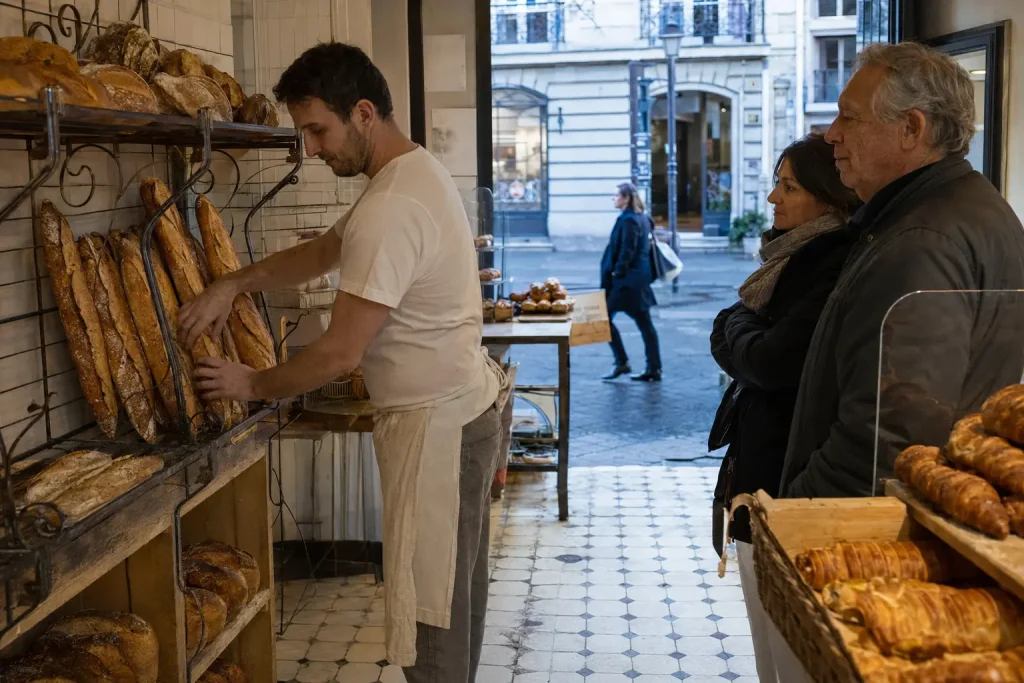
A neighborhood bakery is the easiest introduction to food in Paris because it reveals the everyday hierarchy of bread. A baguette is not one fixed product: the legally defined baguette de tradition française excludes certain additives and generally offers a more developed crust and flavor than the cheapest standard baguette.
Go in the morning, say “Bonjour,” wait for the person ahead to finish and order clearly. A croissant au beurre uses butter; an ordinary croissant may use other fats. Pain au chocolat is the rectangular laminated pastry with chocolate, while pastries filled with cream, fruit or elaborate decoration usually belong more to the pâtisserie side of the counter.
Breakfast in France is generally lighter and sweeter than an American breakfast. A pastry and coffee is plausible; eggs, bacon, fruit, pancakes and several refills are not the default neighborhood ritual. Eat the croissant because it is good, not because it is a culturally mandatory daily allowance.
The bread should be bought close to when it will be eaten. A fresh baguette works for a picnic with cheese, fruit and something salty from a market. By the next morning, it has entered a different career, usually involving toast.
Pastries worth choosing deliberately
Paris has enough pastry to make random selection feel reasonable, but texture matters. A mille-feuille depends on crisp layers against smooth pastry cream. A Paris-Brest combines choux pastry and praline cream. A tarte au citron needs acidity to hold its ground against sugar. Macarons should have a delicate shell and moist interior, not the chew of a souvenir.
Choose one pastry shop for one or two specialties rather than carrying a large mixed box around all afternoon. Many pastries are fragile, temperature-sensitive and less impressive after a Metro journey. Ask which item the shop is known for or what is most seasonal.
The city’s official tourism guide maintains a current overview of Parisian cakes and pastries, including the Paris-Brest, Opéra, mille-feuille and financier. Use the names as a vocabulary, then judge the counter in front of you.
Chouquettes are a useful low-commitment snack: small choux buns with pearl sugar, commonly sold by weight. A flan pâtissier is more substantial, with baked custard in pastry. Both feel closer to ordinary bakery life than a jewel-box dessert queue.
Learn the difference between a café, brasserie and bistro
The categories overlap, and individual businesses use the names loosely, but the distinction helps with expectations.
A café centers on drinks and may serve simple food throughout the day. A brasserie traditionally offers a broad menu and long service hours, making it useful when lunch has slipped past the usual window. A bistro is generally smaller, with a more focused food identity and narrower meal periods.
Paris tourism’s current opening-times guidance notes that lunch commonly falls between noon and 1:30 p.m. and dinner between 8 and 10:30 p.m. A sign reading service continu means food is served through the afternoon. Without it, arriving at 4 p.m. may produce a drink, a cold snack or a politely closed kitchen.
The best choice depends on the day. Use a brasserie when timing and a broad menu matter. Choose a bistro when the meal itself is a priority and reserve if the dining room is small. Sit at a café for coffee, conversation and observation; do not assume its onion soup must be the city’s definitive version.
Build one proper bistro meal
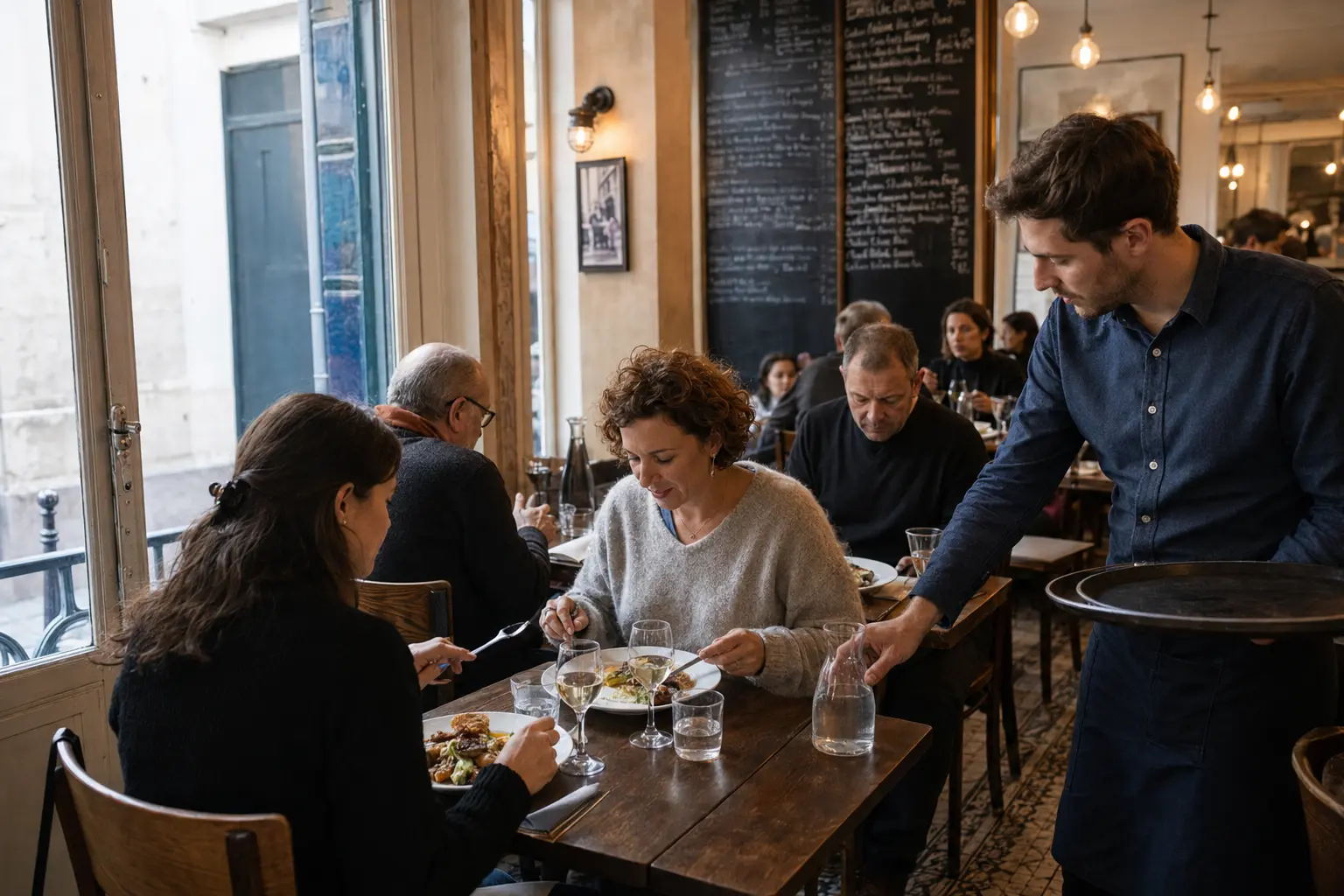
A good Paris bistro meal is often more restrained than the tourist idea of French dining. A short menu may offer a terrine or vegetable starter, one fish, one carefully cooked piece of meat, a seasonal dish and two desserts. Technique appears in stock, sauce, seasoning and timing rather than gold leaf.
At lunch, look for a formule or menu: perhaps starter plus main, or main plus dessert, at a set price. It can offer better value than ordering à la carte and reflects how nearby workers use the restaurant. Read whether the menu is available only at lunch or only on weekdays.
Traditional dishes may include steak-frites, duck confit, blanquette de veau, pâté en croûte, oeufs mayonnaise or pot-au-feu. Not all are specifically Parisian, and not all appear year-round. A restaurant cooking seasonally should not maintain the same heavy stew during a July heatwave merely to complete a visitor’s checklist.
Order what the kitchen appears to care about. If every table has the same daily special, that is more useful evidence than a decade-old list declaring one dish compulsory.
Paris food is not only traditional French food
Paris has been shaped by migration, empire, trade and regional movement within France. Its food cannot be reduced to butter, cream and a set of brasserie standards.
North African restaurants are central to the city’s dining life, from couscous and grilled meats to pastries and mint tea. The neighborhoods around Belleville, La Chapelle, the 10th arrondissement and parts of the 13th hold Chinese, Vietnamese, South Asian, West African, Middle Eastern and mixed contemporary cooking.
The official tourism office describes Paris gastronomy as both traditional and cosmopolitan, with cuisines from across the world contributing to the city. That is not an optional detour from “real” Paris food. It is part of what Paris is now.
Choose at least one meal that reflects this living city. The decision does not require finding the most obscure address. A busy, well-run neighborhood restaurant with a focused menu is a better goal than treating immigrant food as a collectible secret.
Use a food market for ingredients, not just photographs
Paris has more than 80 covered and open-air markets, according to the city’s official market guide. Some operate only on particular mornings; others include permanent covered halls and prepared-food counters.
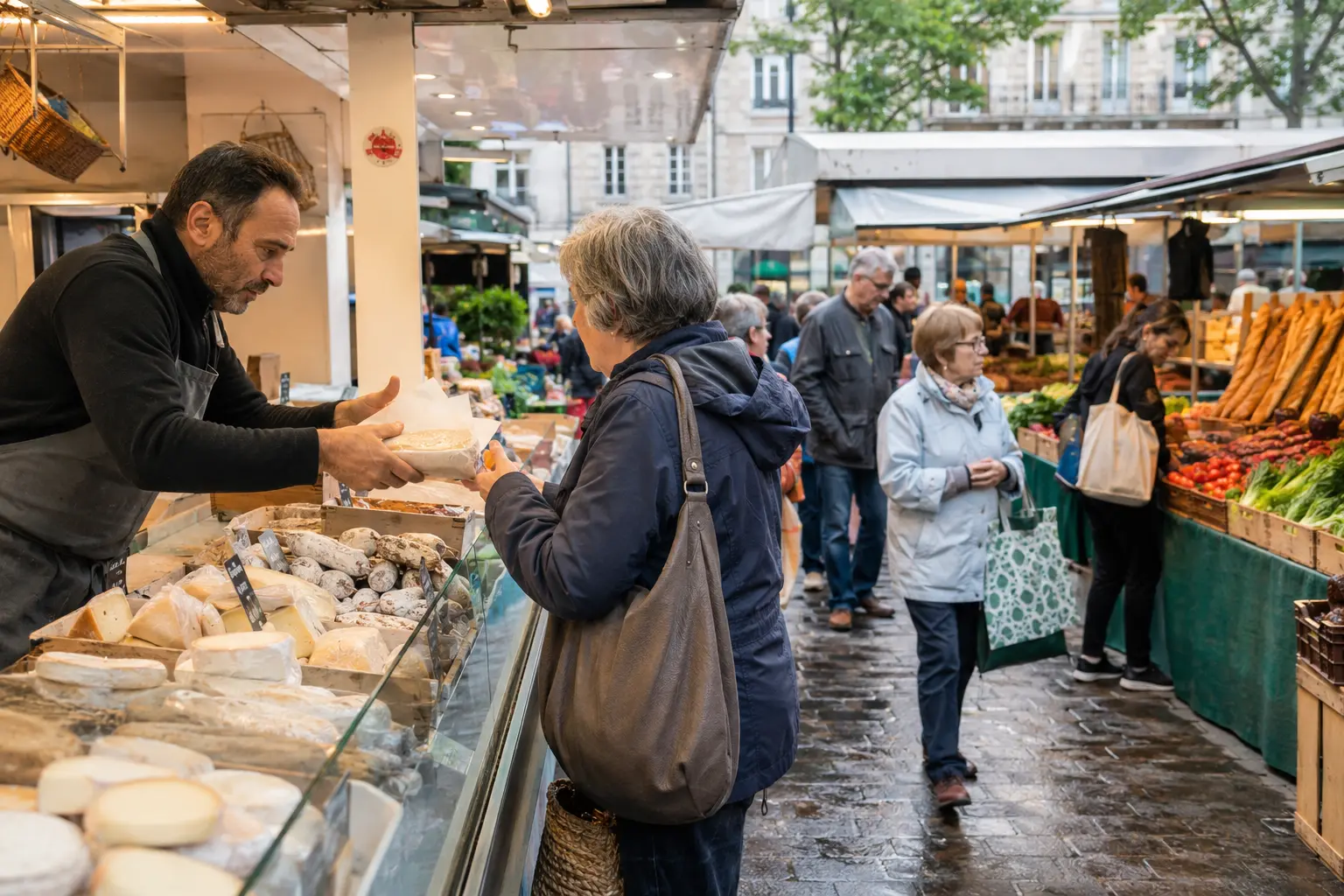
Markets make the most sense when you can buy something useful: fruit for the room, cheese for a picnic, bread, olives, prepared food or flowers. Ask before photographing a seller at close range. Keep bags away from displays and do not handle produce unless the stall’s routine makes self-selection clear.
Marché Bastille is large and accessible on Thursday and Sunday mornings. Marché d’Aligre combines outdoor produce with a covered market and surrounding food shops. Marché des Enfants Rouges is compact and popular for prepared food, which also means it can be crowded at lunch.
Check the current day and hours before crossing Paris. Markets pack down quickly, and arriving near closing may provide bargains or merely a view of vans being loaded.
How to buy cheese without guessing
A fromagerie is useful because ripeness is a service, not just a label. Tell the cheesemonger when the cheese will be eaten, how many people it should serve and whether you prefer mild, strong, soft or firm. A cheese ready tonight may be unpleasant after two days in a warm hotel room.
Choose two or three contrasting pieces instead of a large board. A soft bloomy-rind cheese, a firmer mountain cheese and a goat cheese create variety without exhausting the palate or the budget. Buy a modest amount; the shop can cut it precisely.
Raw-milk cheese rules matter when carrying food back into another country. Check the destination’s customs regulations rather than trusting a market seller to know US import requirements. Vacuum packing may reduce aroma in luggage, but it does not override agricultural law.
Eat cheese as part of a meal or picnic with good bread and fruit. The goal is to taste it at the right condition, not transport a small dairy inventory through three hotel refrigerators.
Coffee, water and the rhythm of the table
An espresso or simply un café means a short black coffee. A café allongé is lengthened with more water; a café crème brings milk. Large milk-heavy coffees are available, especially in specialty shops, but they are not what a traditional counter assumes.
Standing at the bar can cost less than sitting at a table, and a terrace may carry a different price. The menu should make pricing clear. Once seated, the table is generally yours for a less hurried rhythm than many US diners expect.
Tap water is safe to drink. Ask for une carafe d’eau with the meal rather than ordering bottled water by accident. Bread commonly arrives without a separate charge in a restaurant meal.
The server may not bring the bill until asked because leaving diners in peace is part of service, not necessarily neglect. Say l’addition, s’il vous plaît. Pay at the table or the counter according to the restaurant’s routine.
Tipping without importing US rules
Restaurant and café prices in France include service. A tip is therefore not a compulsory percentage added to the bill. Leave a few euros or round up when service was particularly helpful, but do not calculate 20 percent from habit.
Card terminals may not offer a tip screen, and that is normal. Cash is the simplest way to leave a small amount. At higher-end restaurants, guests may tip more for exceptional service, but it remains discretionary.
“Service compris” is not permission to be rude, of course. Begin interactions with bonjour or bonsoir, use s’il vous plaît and acknowledge the person before launching into an English request. Courtesy carries more cultural weight than performing advanced menu vocabulary.
Reservations: what actually needs booking
Reserve a small or popular dinner restaurant when the meal matters, especially Thursday through Saturday. Groups of five or more should book more consistently because many dining rooms cannot rearrange compact tables at short notice.
You do not need to schedule every croissant, café and market visit. Brasseries, casual restaurants and counter-service places preserve spontaneity. Build one or two priority reservations into a trip, then keep the rest flexible by neighborhood.
Confirm the restaurant’s weekly closing day. Independent places often close Sunday, Monday or both, while others open only for dinner. Social media may carry more current holiday information than an old English-language website, but the reservation system or a direct call is stronger evidence.
If arriving late, contact the restaurant. A reserved table is not a claim on an unspecified hour, and a small room may have planned a second seating.
Vegetarian, vegan and allergy-aware eating
Vegetarian dining is easier than old stereotypes suggest, but a traditional menu may still offer only one meat-free main. Contemporary restaurants, international cuisines and dedicated vegetarian places provide more deliberate choices.
Végétarien excludes meat and fish; végétalien means vegan. Explain allergies clearly and carry a written translation that names the ingredient and the risk of cross-contact. “I do not like nuts” and “nuts may cause anaphylaxis” are not the same kitchen instruction.
Butter, cream, stock, gelatin and fish can appear where a translated menu does not make them obvious. Ask rather than infer. For severe allergies, research specialist resources and contact restaurants before booking.
Markets and picnics offer control, but packaged-food labels and bakery staff still matter. A beautiful pastry case is not an allergen-management system.
A realistic food day in Paris
Start with coffee and one pastry from a nearby bakery. Visit a market in late morning if its schedule fits, then eat a weekday bistro lunch using the set menu. Walk afterward; Parisian food becomes more enjoyable when meals are not stacked like attractions.
In the afternoon, choose one pastry or chocolate stop. Dinner can be lighter and less traditional: a neighborhood wine bar with food, couscous, noodles, a casual crêperie or a contemporary small-plate restaurant.
Do not reserve a food tour, tasting menu and famous pastry counter on the same day. Palate fatigue is real, and the most expensive meal suffers when lunch ended at four.
What to skip
Skip restaurants whose main selling point is a laminated menu in many languages and a direct view of a monument, unless convenience is the actual priority. Avoid businesses using staff outside to pull customers in while the dining room sits empty.
Skip a long cross-city journey for a single viral croissant unless pastry is the purpose of the morning. Paris has excellent bakers across many neighborhoods, and freshness matters more than online fame.
Do not reject every famous institution as touristy. Some endure because they perform a specific tradition well. Judge the experience, price and timing rather than treating popularity as proof either for or against quality.
The best way to eat in Paris
Use Paris food as a way to understand the city’s daily structure. Buy bread when it is fresh, eat lunch when kitchens are cooking, ask a cheesemonger what is ready and leave room for the cuisines that contemporary Parisians actually eat.
One excellent bakery, one thoughtful market purchase and one well-chosen bistro meal will reveal more than a frantic list of “must-eat” dishes. The point is not to consume Paris before checkout. It is to notice how food organizes the day.
Frequently Asked Questions
What food should you try in Paris?
Excellent bread and viennoiserie, a seasonal bistro lunch, cheese bought with advice, one precise pastry rather than a box chosen for photographs, and dishes reflecting the city's working-class as well as bourgeois history, alongside its North African, Jewish and Vietnamese food traditions.
Where should you buy bread and pastry in Paris?
Buy bread from a boulangerie, pastry from a pâtisserie, cheese from a fromagerie and a cooked meal from a restaurant. A café facing a major monument may serve all four, but that convenience usually isn't the most delicious option.