Where to stay in Singapore is less about finding the one “perfect” neighborhood than choosing which part of the day you want to make easy. The city’s MRT is excellent, but tropical heat makes a 15-minute walk feel longer, interchanges add friction, and the polished view outside a hotel window may not help when you want dinner at 10 p.m.
For most first-time visitors, City Hall/Bras Basah or Bugis is the most useful all-round base. Both keep several sightseeing districts within a short ride and give you food, shops, and covered indoor escapes close to the hotel. Choose Chinatown or Tanjong Pagar if eating and evening street life matter more; Marina Bay for the view and a short luxury stay; Orchard for shopping and full-service hotels; or Sentosa only when the resort is a central part of the trip.
The quick answer: which area should you choose?
| Area | Best for | Main advantage | Main compromise |
|---|---|---|---|
| City Hall and Bras Basah | First visits and short stays | Central, walkable to museums and served by several useful stations | Weekday traffic and premium hotel rates |
| Bugis and Kampong Glam | Food, character, and good transport | Lively from morning into the evening, with Downtown and East–West line access | Some streets are busy and noisier at night |
| Chinatown and Tanjong Pagar | Hawker food and evening convenience | Strong dining choice and easy access to the CBD and river | Immediate surroundings vary from heritage lanes to office blocks |
| Marina Bay | Skyline views and a special hotel stay | Major waterfront sights outside the door | High rates and less everyday neighborhood life |
| Orchard Road | Shopping, families, and hotel facilities | Malls provide air-conditioned dining and weather-proof convenience | Less atmospheric after shopping hours |
| Clarke Quay and Robertson Quay | Riverside evenings | Easy return after drinks or dinner | Clarke Quay can feel commercial; Robertson Quay is farther from the MRT |
| Little India | Value, food, and street energy | Distinctive neighborhood life and useful transport | Visually and aurally busy; hotel quality varies |
| Sentosa | Resorts, beaches, and attraction-focused families | Vacation facilities are concentrated together | Inconvenient for repeated central-city sightseeing |
If two areas look equally appealing, choose the hotel with the simpler walk to an MRT entrance. A five-minute shaded route usually improves a trip more than a marginally better skyline view.
City Hall and Bras Basah: the best all-round base for a first visit
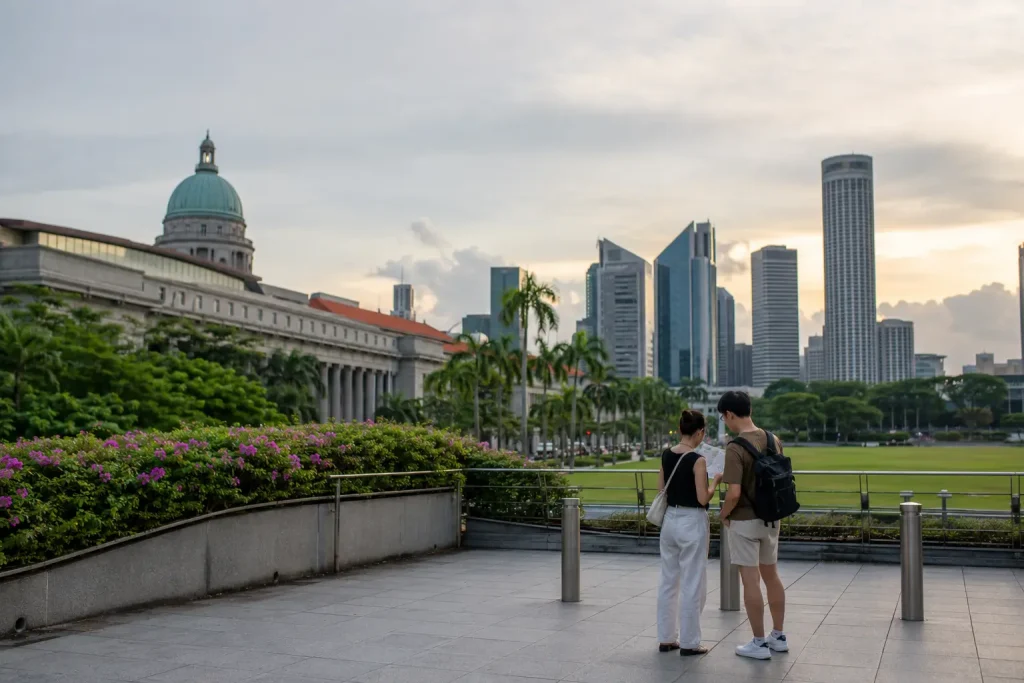
City Hall and Bras Basah sit between the Civic District, Marina Bay, Bugis, and Orchard. The National Gallery, Asian Civilisations Museum, Fort Canning, CHIJMES, and the Esplanade are within walking range, while City Hall is an interchange for the North–South and East–West lines. Bras Basah and Bencoolen add Circle and Downtown line access nearby.
This is the best area to stay in Singapore if you have three or four days and want to spend less time diagnosing the rail map. You can walk to a museum in the morning, retreat indoors during a downpour, then reach Chinatown, Little India, or Gardens by the Bay without turning the day into a transport exercise.
The compromise is price. Hotels around the civic core frequently charge for their location, and parts of the district become quiet after offices and cultural venues close. Check the precise entrance: a property described as “City Hall” may sit on the far side of a large road system or mall.
Bugis and Kampong Glam: the best balance of transport and neighborhood life
Bugis works unusually well because it is both a transport point and a place you may actually want to return to. Bugis station serves the East–West and Downtown lines, making trips toward Changi, Chinatown, Bayfront, and the central business district straightforward. Kampong Glam, Arab Street, Haji Lane, and the Bras Basah arts district spread out around it.
Stay here if you want breakfast choices, casual dinners, independent shops, and streets that remain active beyond office hours. It feels more textured than Marina Bay without sacrificing much convenience. The area also offers a broader range of hotel prices than the waterfront.
Not every block has the same atmosphere. The streets closest to Bugis Junction are intensely commercial, while lanes near Kampong Glam can be louder in the evening. Light sleepers should read recent room reviews for street noise rather than judging by the neighborhood name alone.
Chinatown and Tanjong Pagar: the best area for food after sightseeing
Chinatown places hawker centers, temples, shophouses, bars, and several MRT options within a compact area. Tanjong Pagar, immediately to the south, mixes conserved streets with towers, Korean restaurants, cocktail bars, and quick access to the CBD. Outram Park is a particularly useful interchange if your hotel lies on its eastern side.
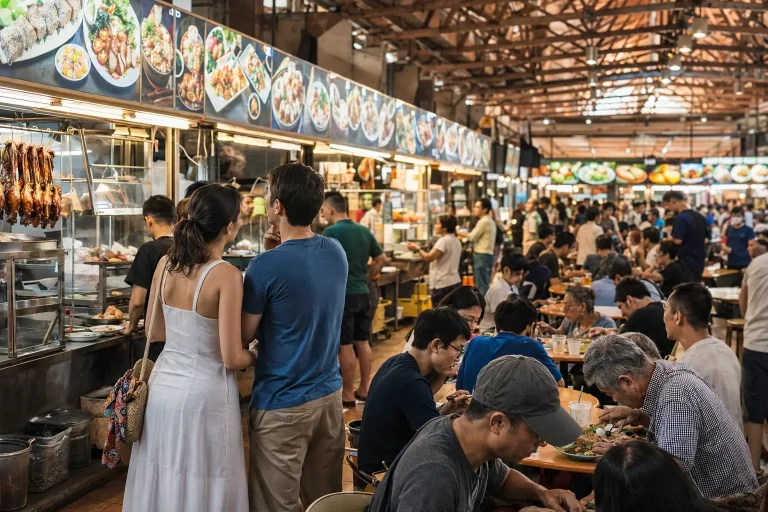
Choose this zone if the question “where will we eat tonight?” is likely to decide the final hours of each day. You can return, shower, and walk back out rather than making a special cross-city journey for dinner. It is also practical for the river, Marina Bay, and southern neighborhoods.
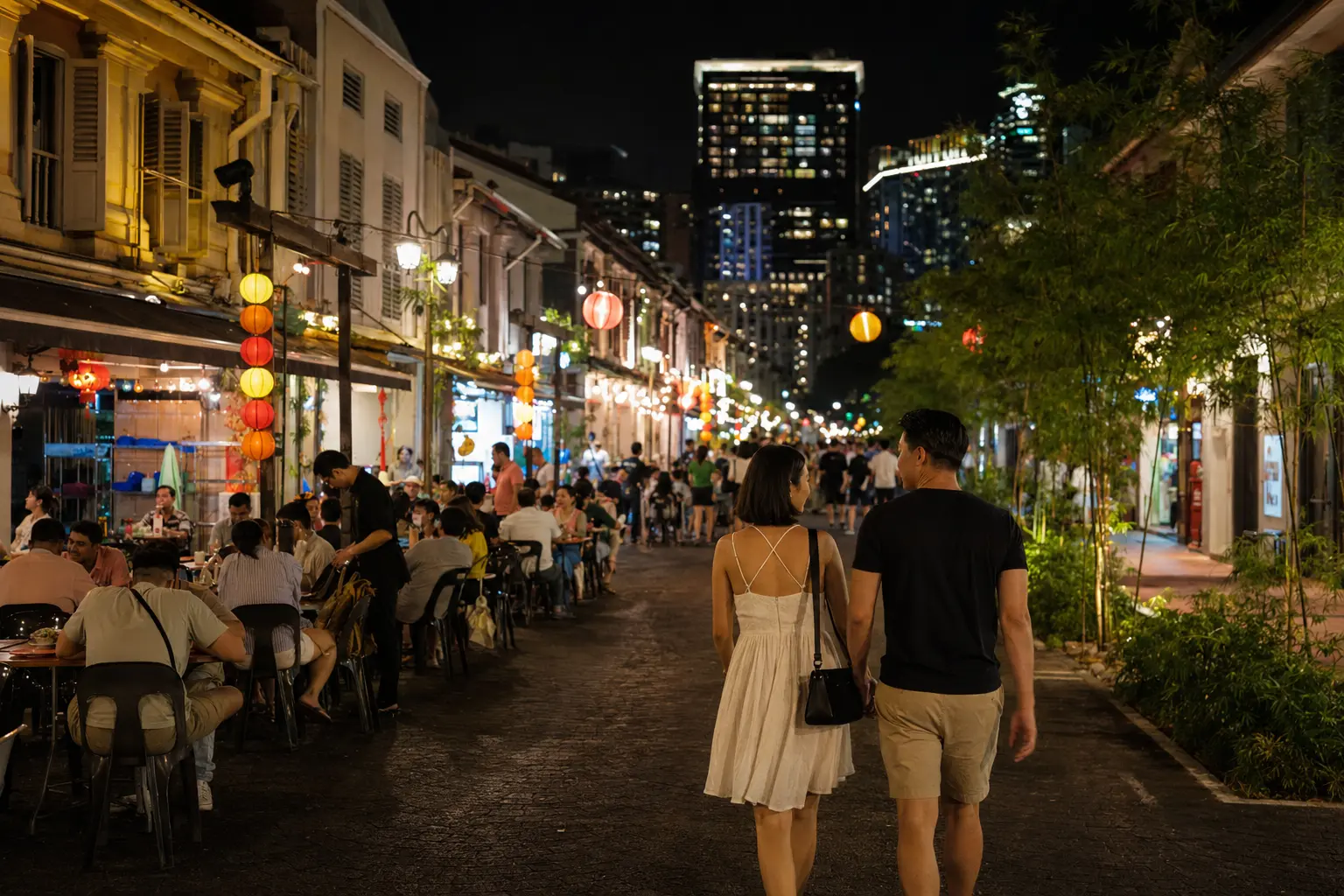
The broad label “Chinatown hotel” hides meaningful differences. A room beside a nightlife lane will not feel like one near a quiet office edge. Look at the walking route after dark, nearby hawker-center closing patterns, and whether the hotel is closer to Chinatown, Maxwell, Telok Ayer, or Outram Park station.
Marina Bay: worth paying for when the stay is part of the experience
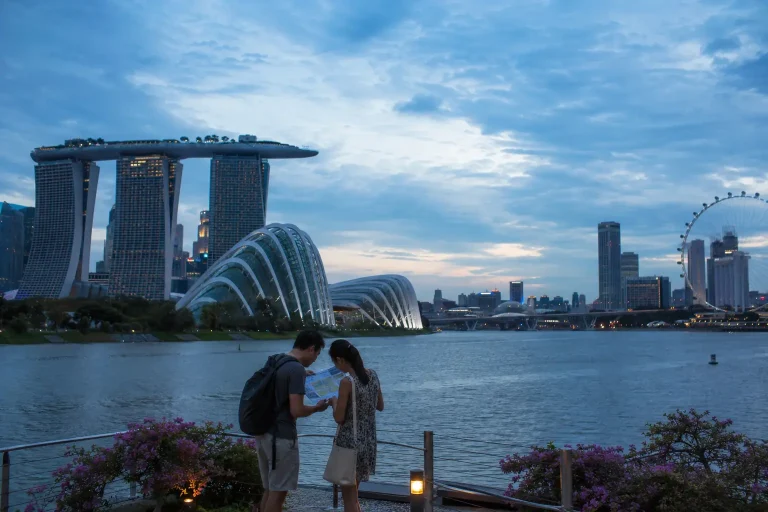
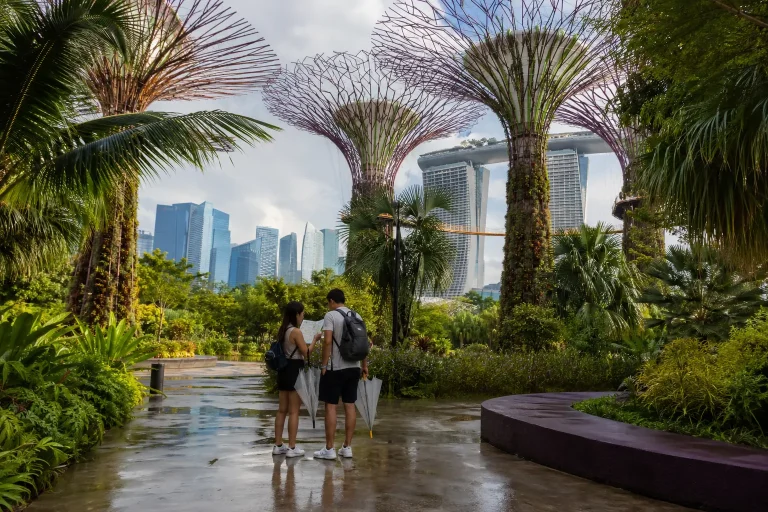
Marina Bay gives you Singapore’s most recognizable contemporary landscape: Gardens by the Bay, the waterfront promenade, ArtScience Museum, the Helix Bridge, and nightly skyline views. For a one- or two-night celebration, a bay-facing room or rooftop pool can be a genuine experience rather than merely somewhere to sleep.
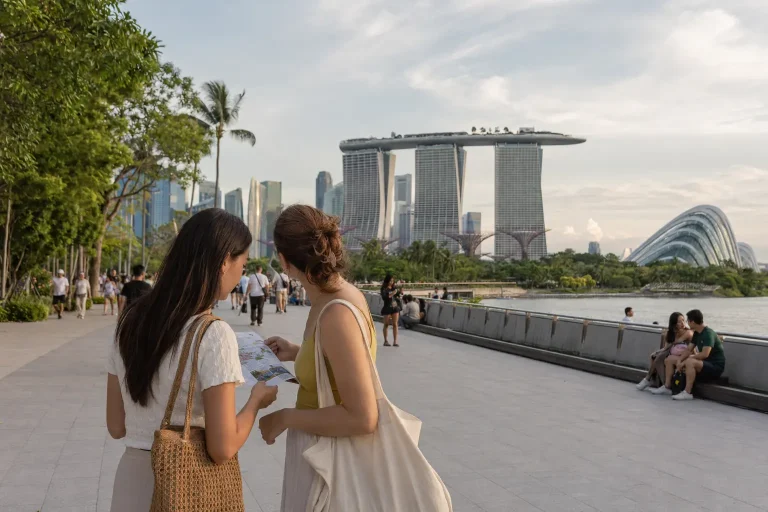
It is not automatically the most convenient base. The bay is large, shade is inconsistent, and places that look adjacent across the water may require a long walk or a train change. Dining tends toward malls, hotels, and destination restaurants, with less ordinary street life than Bugis or Chinatown.
Pay the premium if you will use the hotel facilities and enjoy the waterfront more than once. If the room is mainly a place to leave luggage, stay centrally elsewhere and visit the bay in late afternoon and evening.
Orchard Road: easiest for shopping and weather-proof convenience
Orchard Road suits travelers who want large hotels, pools, family rooms, international dining, and shopping within an air-conditioned chain of malls. When a downpour arrives or children run out of enthusiasm, being able to find food, pharmacies, and indoor space without crossing the city is not trivial.
The road is long. An “Orchard” address may be near Orchard, Somerset, Dhoby Ghaut, or farther west, and those positions create different journeys. Dhoby Ghaut is the most useful interchange; Orchard and Orchard Boulevard are convenient for the central shopping stretch.
Choose Orchard because you will shop or value full-service comfort, not because guidebooks call it central. Travelers seeking hawker centers and heritage streets may spend most evenings leaving the district.
Clarke Quay and Robertson Quay: best for riverside evenings
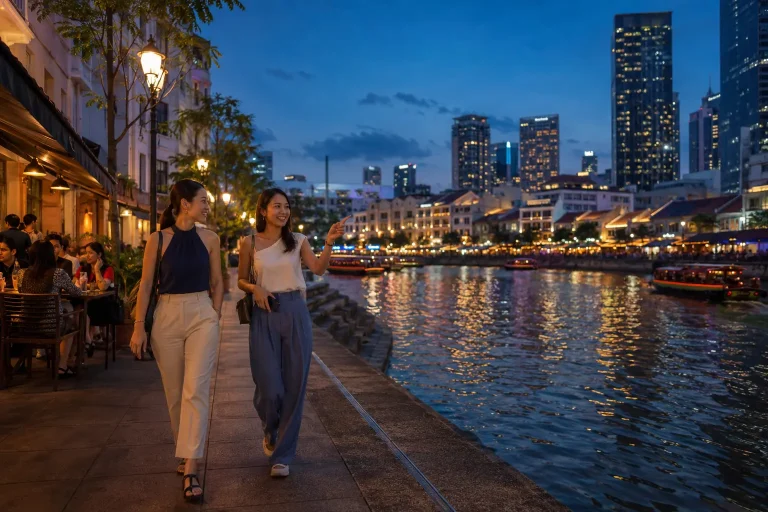
Clarke Quay is convenient for bars, restaurants, river walks, and easy access to Chinatown and Fort Canning. The MRT station keeps the area connected, while the waterfront makes an agreeable route home after dinner. It is a sensible choice for a short social trip.
Robertson Quay is calmer and more residential, with riverside restaurants and apartment-style accommodation. Its weakness is transport: depending on the exact property, the walk to an MRT station may be longer than the hotel description suggests. Buses and taxis compensate, but the difference matters in heat or rain.
Neither area is Singapore’s only nightlife district, and Clarke Quay’s polished entertainment complex can feel manufactured. Stay here for an easy riverside evening, not for the promise of discovering the city’s entire after-dark personality outside your lobby.
Little India: strong value with the most immediate street energy
Little India offers temples, produce shops, flower garlands, restaurants, 24-hour retail, and a dense everyday rhythm that contrasts sharply with Marina Bay. Little India station links the Downtown and North East lines; Jalan Besar and Farrer Park may also be useful depending on the property.
Accommodation can be better value, including hostels and straightforward midrange hotels. It works well for independent travelers who prioritize food and neighborhood observation over resort-like calm.
The area is busy, particularly on weekends, and room standards differ greatly within the same price band. Read reviews for window insulation, room size, and maintenance. “Authentic” is not a substitute for a quiet night or functioning air-conditioning.
Sentosa: stay only when Sentosa is the trip
Sentosa is the right base for families dedicating substantial time to Universal Studios Singapore, beaches, resort pools, or the island’s other attractions. Staying there reduces the tiring end-of-day transfer and lets a resort day remain a resort day.
For a first visit centered on the city, it creates the opposite effect. Reaching Chinatown, the Civic District, Little India, or the Botanic Gardens repeatedly becomes a commute via the island’s connections and HarbourFront. Evening food choices are also more resort-oriented.
A split stay can work: spend the city portion in Bugis, City Hall, or Chinatown, then move to Sentosa for the final night or two. Do not change hotels for a single attraction day unless the resort experience itself justifies the packing.
Areas that work for specific trips
Tiong Bahru for cafés and slower mornings
Tiong Bahru combines an admired food market, low-rise prewar housing, bakeries, bookstores, and a quieter residential scale. It suits repeat visitors and travelers who enjoy beginning slowly. The MRT is useful, but many appealing streets are not immediately beside the station, so check the hotel’s actual walking position.
Joo Chiat and Katong for east-side food and architecture
Joo Chiat and Katong offer Peranakan architectural detail, excellent local food, and a more lived-in east-coast setting. Newer Thomson–East Coast line access has improved connectivity, but this remains a deliberate neighborhood choice rather than the most efficient first-time base.
Changi Airport for a layover, not a city holiday
An airport hotel makes sense after a very late arrival, before an early departure, or during a layover built around Jewel. For a multi-day Singapore visit, the repeated journey into the center outweighs the convenience of the first and last hour.
How close to the MRT is close enough?
Hotel listings often measure distance in a way that flatters the property. In Singapore, look for the route rather than the number:
- Is the walk under eight minutes at an ordinary pace?
- Does it have shade, a covered link, or an indoor mall connection?
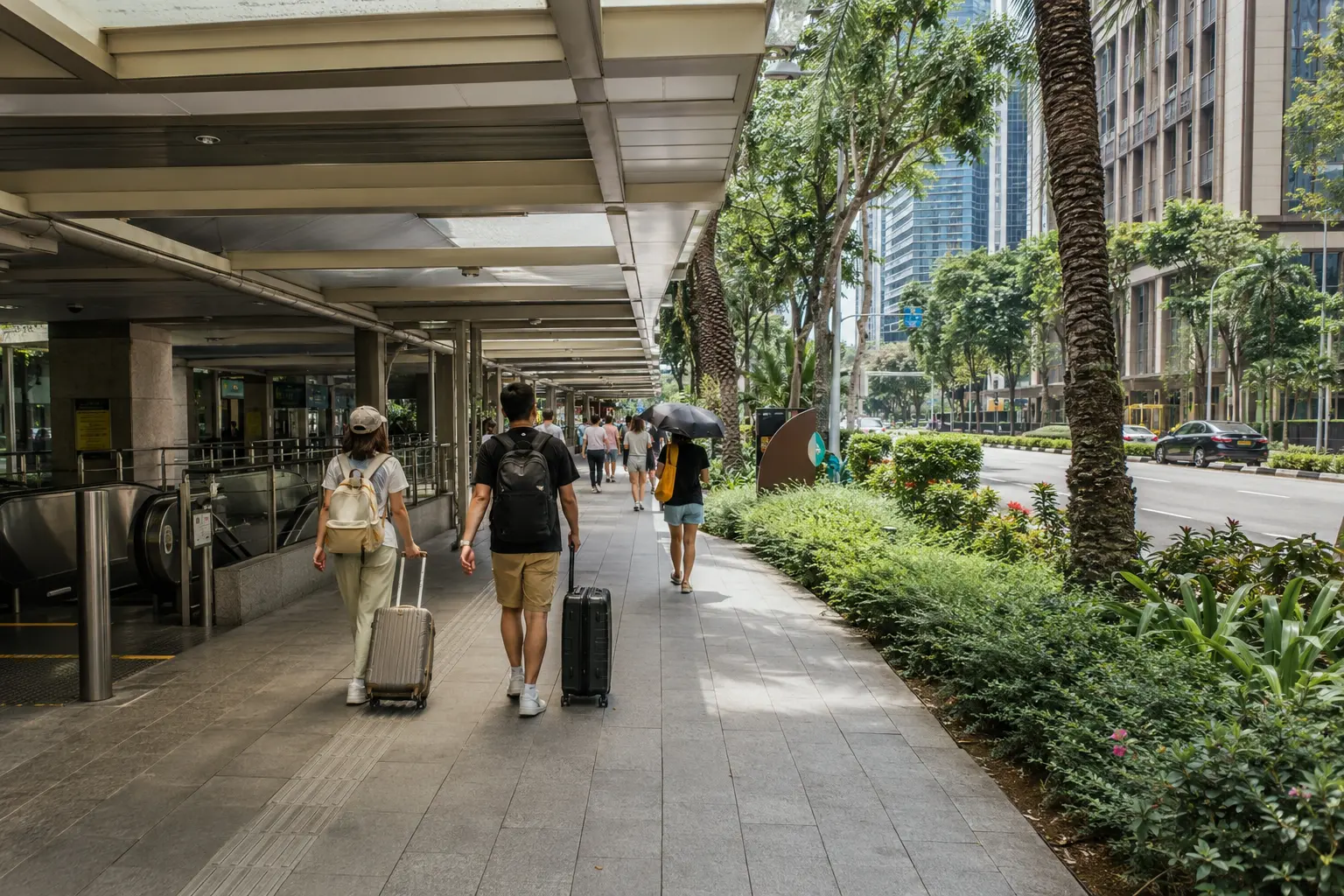
- Must you cross a wide road or use an overhead bridge?
- Is the nearest entrance the one that leads conveniently to your platform?
- Will the same route feel reasonable with luggage or after a long humid day?
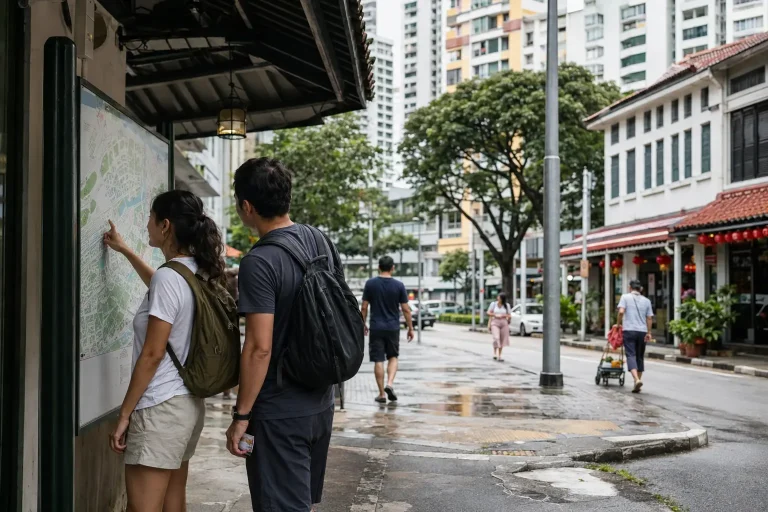
The Land Transport Authority’s official rail map is useful for lines and interchanges, but a street map reveals the last 500 meters. A slightly smaller room beside a useful station can be a better purchase than a glamorous property that requires a sweaty walk twice a day.
What first-time visitors often get wrong
Choosing Marina Bay because it looks central on a skyline map
The waterfront landmarks are close visually but distributed around a large bay. A hotel elsewhere may provide faster access to a broader set of neighborhoods.
Treating all central MRT stations as equivalent
An interchange can remove a transfer, but a huge station may add walking underground. Compare the journeys you will actually take, not the total number of colored lines nearby.
Booking a cheap room before checking its legal and practical reality
Singapore’s ordinary private homes are not a casual short-term rental market. Verify that accommodation is licensed and offered through a legitimate operator. Extremely low hotel prices may also mean a tiny windowless room, poor soundproofing, or a location described more generously than it deserves.
Ignoring the final hour of the day
Morning sightseeing is easy from most central areas. The better test is where you want to be after dinner, when tired feet make another transfer irritating. A neighborhood with food and a pleasant short walk home often creates more value than saving five minutes on the first museum journey.
Where to stay for two nights, families, and tighter budgets
For only two nights, choose City Hall/Bras Basah, Bugis, or Chinatown and stay close to a station. The goal is not to “see everything”; it is to avoid spending a short visit changing trains and crossing the island.
Families often do well around City Hall, Orchard, or Bugis because malls, food courts, pharmacies, and indoor space are easy to reach. Sentosa works when attraction days dominate. Check whether a “family room” has real beds rather than a sofa arrangement that makes the floor plan theoretical.
Budget travelers should compare Little India, Lavender, Jalan Besar, and the edges of Chinatown, but price must be read alongside room size, windows, noise, and station access. Singapore is compact enough that a well-connected room outside the postcard core can work; it is not so frictionless that every cheap address is equal.
A simple booking test before you pay
Open your map and plot three places you genuinely expect to visit, one dinner area, and the airport route. Then inspect the hotel-to-station walk at street level. If most trips require one direct train or a simple interchange, and you can still eat near the hotel after 9 p.m., the location is doing its job.
The best place to stay in Singapore is rarely the district with the longest attraction list. It is the base that makes your own mornings, weather breaks, and late returns uncomplicated. For a balanced first trip, start with City Hall/Bras Basah or Bugis; move to a more specialized neighborhood only when you know what convenience you are willing to trade.
Frequently Asked Questions
Where is the best area to stay in Singapore for first-time visitors?
City Hall/Bras Basah or Bugis is the most useful all-round base for most first-time visitors. Both keep several sightseeing districts within a short ride and put food, shops, and covered indoor escapes close to the hotel.
Which Singapore neighborhood is best for nightlife and food?
Chinatown or Tanjong Pagar work well when eating and evening street life matter more than central sightseeing convenience.