

For most flights from a U.S. airport, arrive at the terminal two hours before a domestic departure and three hours before an international departure. That is a useful default, not a promise. Add time for checked bags, airport parking, terminal transfers, holiday crowds, young children, mobility assistance or document checks.
If you are carry-on only, already checked in and leaving from a small airport you know well, you may need less. But calculate from the time boarding ends—not the departure time printed in the largest type. The plane is allowed to leave without anyone still contemplating the security line.
How early should you get to the airport?
| Trip | Sensible starting point | Consider arriving earlier when… |
|---|---|---|
| Domestic, carry-on only | 2 hours before departure | The airport is large, unfamiliar or busy |
| Domestic, checked bag | 2 to 2½ hours before | You have special items, a pet or counter service |
| International departure | 3 hours before | The airline or departure airport gives a longer requirement |
| Peak holiday or major event | Add at least 30–60 minutes | Parking, roads and checkpoints are all forecast to be busy |
| Traveler needing assistance | Add time requested by the airline | Wheelchair service, medical screening or family logistics apply |
The correct clock starts at the terminal entrance. A “two-hour arrival” does not mean pulling into an economy parking lot two hours before takeoff. The shuttle ride, rental-car return and wrong-terminal detour all happen before airport arrival in the useful sense.
The airline cutoff is not your target
Airlines publish minimum check-in, bag-drop and gate times. These are hard operational deadlines: arrive after one and the airline may refuse the bag, release the seat or close the aircraft door. They are not recommended arrival times.
For example, Delta currently recommends arriving at least two hours before a U.S. domestic flight, while its usual minimums are 45 minutes for checked baggage, 30 minutes for check-in without a bag and 15 minutes at the gate. For international trips it suggests three hours and, at most airports, requires check-in at least one hour before departure. American likewise notes that its most-city check-in minimums vary between domestic and international travel and that some airports require more time.
Always check the operating airline’s page for your exact departure airport the day before travel. A codeshare sold by one airline but flown by another generally follows the operating carrier’s airport process. Temporary construction, a terminal change or a local document rule can matter more than a national rule of thumb.
Work backward from the closed aircraft door
A calm airport plan has six parts. Start with scheduled departure and subtract each one:
- Boarding buffer: aim to be at the gate before boarding begins, commonly 30–50 minutes before departure.
- Walk or train to the gate: allow 10–25 minutes at a large terminal, more if a concourse train is involved.
- Security screening: use the airport’s current estimate, then retain a margin for a line that moves less elegantly than advertised.
- Bag drop or counter visit: add the queue plus enough room to beat the airline cutoff.
- Terminal entry: include curb congestion, finding the correct door and any terminal shuttle.
- Parking or rental-car return: count this separately from airport time.
Suppose a domestic flight leaves at 9:00 a.m. and boarding begins at 8:20. You want to reach the gate by 8:10, expect a 15-minute walk, allow 35 minutes for security and 20 minutes for bag drop. That puts you at the terminal by 7:00—exactly the standard two-hour recommendation. If off-site parking adds a 25-minute shuttle, arrive at the parking facility around 6:30 rather than calling 7:00 “close enough.”
When to add more time
You are checking a bag
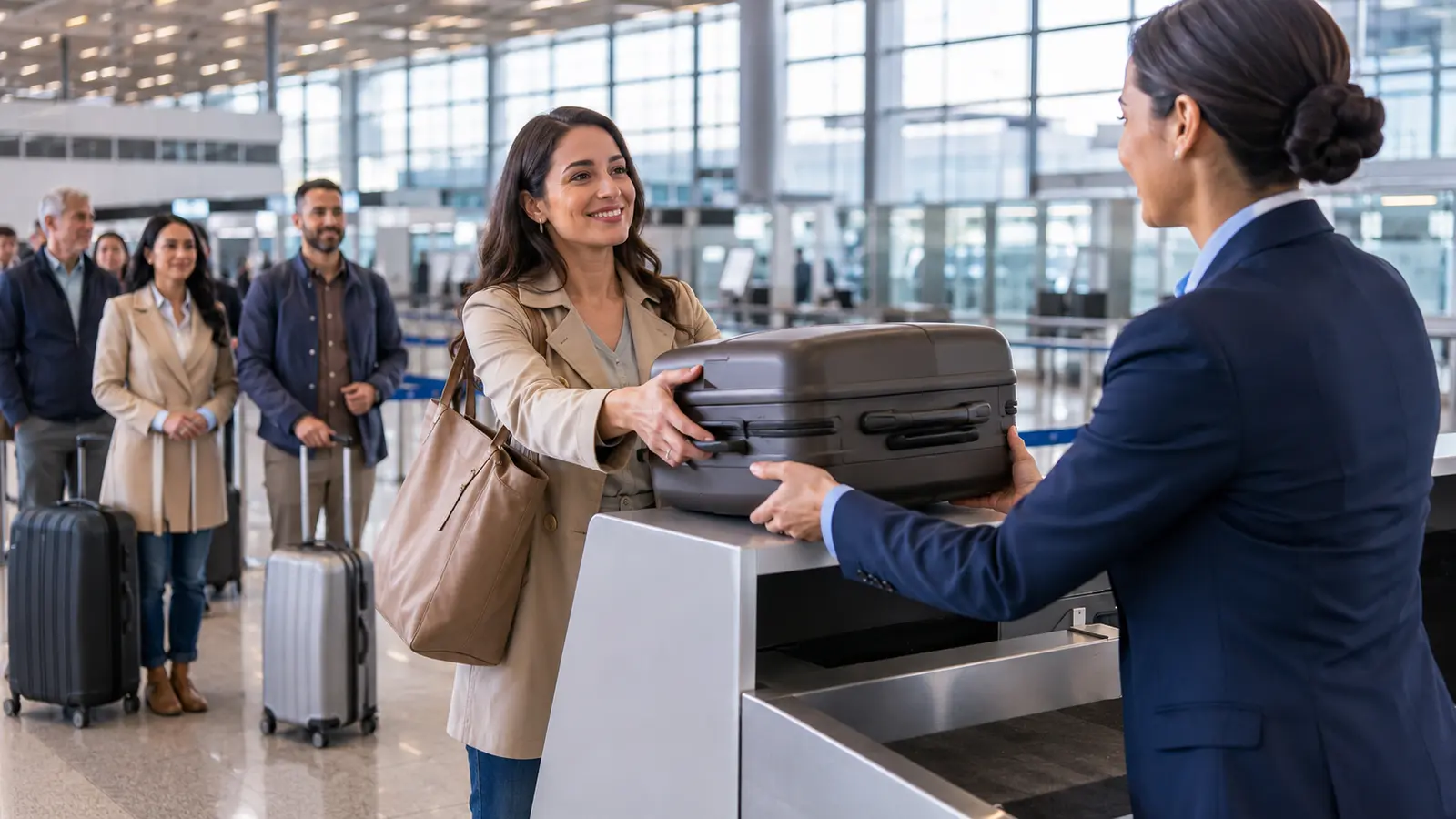
A checked-bag cutoff can be earlier at particular airports, and the queue does not pause because you joined it before the deadline. Oversize luggage, sports equipment, a firearm, a pet or an unpaid bag may require an agent rather than the fastest self-service lane. Keep medication, documents and irreplaceable items in the carry-on you keep with you.
You are flying internationally
The extra hour is often used for passport and visa checks, baggage processing and earlier gate requirements—not necessarily outbound immigration at every U.S. airport. Confirm that the name on the reservation matches the passport and gather any destination documents before joining the counter line. The international travel checklist covers the paperwork, payment and phone preparation that should already be finished.
The airport is large or unfamiliar
One airport code can contain several terminals connected by buses, trains or a surprisingly committed walk. Verify the departure terminal, not the terminal where the airline usually operates. At airports undergoing construction, allow extra time for road diversions and changed check-in locations.
You are traveling at a peak time
Early morning can be busy because many flights depart in a tight bank. Friday afternoons, Sunday evenings, school breaks and holiday periods add crowds at parking, counters and security simultaneously. Check the airline, airport and TSA alerts on the day of departure; last year’s queue time is charming history, not a plan.
Your group moves at a different pace
Children, a large friend group, mobility equipment or an airport assistance booking can add several handoffs. Use the airline’s requested arrival time and arrange assistance in advance. Give one person responsibility for documents and another for counting bags; collective responsibility has a habit of becoming nobody’s responsibility.
When a shorter arrival may be reasonable
A shorter plan can work for a domestic flight when all of these are true:
- You have checked in online and hold a valid boarding pass
- You have no checked bag or counter task
- You know the airport, terminal and ground-transport routine
- The airport is small and current security conditions are light
- You are not traveling during a peak period
- Missing the flight would not damage an expensive onward itinerary
This is a risk choice, not a hidden efficiency trick. TSA PreCheck or another expedited lane may reduce typical screening friction, but it does not remove traffic, a parking shuttle, an identity problem or a last-minute gate change.
Prepare the night before, not in the security line
Check in online, save the boarding pass offline and verify the terminal. Review flight status and airline advisories. If you are packing carry-on liquids, follow the current rules in the guide to traveling with liquids on a plane so a preventable bag search does not consume the buffer.
Put identification in one reachable place, charge the phone and confirm the route to the airport at the actual departure time. Add the flight, terminal, parking reservation and leave-home time to the same system you use to organize the rest of the trip. A 6:15 a.m. departure rarely improves after a midnight hunt for the passport.

A simple departure-day timing checklist
- Confirm the flight is operating and note the current terminal
- Check in and review the airline’s airport-specific cutoff
- Check current road, parking, terminal and security conditions
- Count time from parking or rental return to the terminal
- Aim to reach the gate before boarding starts
- Keep a small buffer after every estimate, not only at the beginning
If your flight follows a long drive or another booking, build it into a realistic travel itinerary. Airport time is part of the day’s schedule, not white space between breakfast and takeoff.
Frequently asked questions
Is two hours early enough for a domestic flight?
Usually, yes, as a starting point at a U.S. airport. Add time for checked bags, off-site parking, a large or unfamiliar terminal, peak travel periods or special assistance. Check the airline’s exact cutoff because airports can have exceptions.
Do I really need to arrive three hours early for an international flight?
Three hours is the common recommendation because international departures can add document checks, longer bag deadlines and earlier gate requirements. Your airline or airport may specify more or less, but do not substitute a domestic routine without checking.
How early should I arrive if I have TSA PreCheck?
PreCheck can shorten the security step, but the standard arrival guidance remains a safe default. Only trim time after accounting for parking, bag drop, terminal distance, the current checkpoint and the consequence of missing the flight.
Does “arrive at the airport” mean parking or entering the terminal?
Treat it as entering the correct terminal. Add rental-car return, parking, shuttle and curb time before that point. At a large airport, those landside steps can take longer than security.
How early is too early?
Very early arrivals can run into closed airline counters or limits on how many hours before departure a checked bag is accepted. If you plan to arrive more than four hours early, check when the counter and lounge open and whether you can enter the secure area.
The useful goal is not maximum airport time. It is enough margin that one ordinary delay does not turn into a missed flight. Begin with two hours domestic or three hours international, then add the frictions your trip actually contains. That is usually a better calculation than hoping the terminal will admire your confidence.